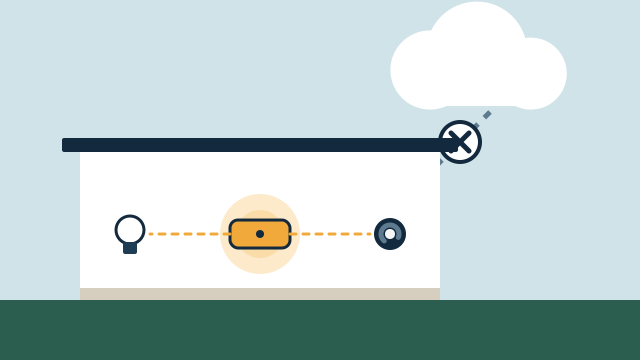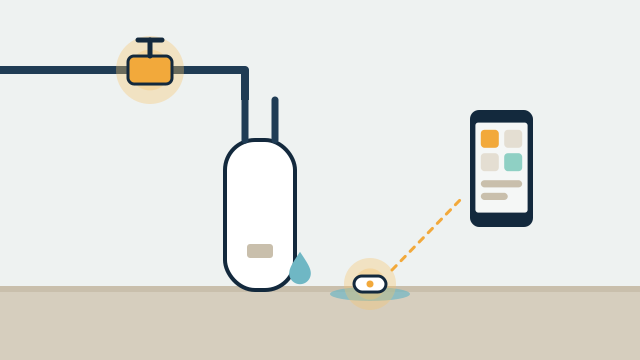
A water leak system has two parts that people often blur together. Sensors detect water and send an alert. A shutoff valve, if you have a supported one, can close the water supply when a sensor trips. Planning well means putting sensors where leaks actually start, choosing a valve that fits your plumbing, and knowing in advance what still works when the power or internet is out.
What does a leak sensor actually do?
A leak sensor reports water touching its probes, and that is all. It does not stop the water. On its own, it gives you a notification, a local chime, or both, depending on the model.
Most sensors are small battery-powered pucks that sit on the floor. Some have a remote probe on a thin cable so the sensor body can stay dry while the probe sits in a drain pan or behind an appliance. Many also report temperature, which can be useful in a closed-up home. They connect over a wireless protocol, commonly Zigbee, Z-Wave, Thread, Wi-Fi, or a brand’s own radio paired to a hub.
The type of connection matters for what happens next. A sensor that talks to a hub in the home can trigger a valve locally. A Wi-Fi sensor that only reports to the maker’s cloud needs the internet before anything else can react.
Where should leak sensors go in a Florida home?
Put sensors where water is stored, moves under pressure, or drains, and where a leak could run unnoticed. In South Florida homes, the air conditioning system deserves the first sensor because it runs almost all year and produces condensate constantly.
| Location | Why it matters | Placement tips |
|---|---|---|
| AC air handler and condensate line | Condensate drains can clog, and the pan can overflow into a closet, attic, or ceiling | Probe in or beside the secondary drain pan; many systems also have a float switch that shuts the AC off on overflow |
| Water heater | Tanks and fittings can fail with little warning | On the floor or in the drain pan, near the base |
| Washing machine | Supply hoses are under constant pressure | Behind the machine, near the hose connections |
| Under kitchen and bath sinks | Supply lines, drains, and disposals | Inside the cabinet, at the back where water collects |
| Refrigerator ice maker or water line | Thin supply lines behind the fridge are easy to kink or crack | On the floor behind the unit, with a remote probe if space is tight |
| Toilets | Supply line and fill valve | On the floor beside the supply valve |
| Dishwasher | Supply and drain connections | In the toe-kick area if accessible, or the adjacent sink cabinet |
Two practical notes. First, a sensor detects only the water that reaches it, so place it at the low point where water would pool. Second, the AC float switch and a smart leak sensor do different jobs. The float switch protects the system by cutting the AC; the sensor tells you something is wrong. Keeping both is common.
Illustrative example: A Coral Gables homeowner wants peace of mind about the attic air handler. The plan places a probe-style sensor in the secondary pan, a second sensor at the water heater, and one under each sink. A leak at the air handler sends an alert and, because the home has a supported valve actuator on the main, also closes the supply. A drip under a bathroom sink only sends an alert, since that is easier to handle in person.
How do automatic shutoff valves work with sensors?
A shutoff valve closes the water supply when told to, either by a sensor event, a schedule, or a manual command from an app or wall control. There are three common approaches, and the right one depends on your plumbing.
Actuator on an existing valve. A motorized unit clamps onto a quarter-turn ball valve and turns its handle. It avoids cutting pipe, but it only works with a compatible valve in reasonable condition, with enough space around it. Old gate valves with round handles generally are not suitable.
In-line motorized valve. A new valve body is installed on the supply pipe. This is plumbing work. Moen, for example, recommends that its Flo Shutoff be installed by a licensed plumber or installer.
Flow-monitoring shutoff. Some in-line devices measure flow and pressure and can flag patterns that look like a leak, such as water running for an unusually long time. They can catch some leaks that no spot sensor touches, but they also need tuning to your household’s normal use.
Whatever the type, the valve must be supported by the platform you use. We verify the exact model and firmware before promising that a given sensor can close a given valve. Valve installation on the main supply is coordinated with a licensed professional where required.
Which fixtures does a main shutoff affect?
Closing the main stops water to the whole property, including toilets, the ice maker, and often irrigation if it shares the same supply. That is usually what you want for an empty home. For an occupied home, some owners prefer the valve to close automatically only for certain sensors, or only when the house is in an “away” mode, and to alert without closing otherwise.
What happens during power and internet outages?
It depends on where each piece gets its power and where the decision to close the valve is made. This is the part most worth planning, because outages after storms are a normal part of life here.
| Component | Power outage | Internet outage |
|---|---|---|
| Battery leak sensor | Keeps sensing | Keeps sensing |
| Hub or controller | Stops unless on a UPS (battery backup) | Local automations keep running on many platforms |
| Router and modem | Stops unless on a UPS | Phone alerts usually cannot be delivered |
| Valve actuator | Stops unless it has battery backup; typically stays in its last position | Can still close if the automation runs locally |
| Cloud-only Wi-Fi sensor | Depends on its own battery and the router | Usually cannot trigger anything |
A system where the sensor, hub, and valve all communicate locally can close the valve without the internet. Home Assistant’s own documentation, for example, says it runs on hardware in your home and can keep working when the internet is down, while devices that rely only on a vendor’s cloud can’t be reached during an outage. Other platforms behave differently, and the details are worth confirming for your specific equipment. Our article on local control versus cloud automation covers this in more depth.
Remote notifications are another matter. To reach your phone, the alert generally needs the internet. Putting the modem, router, and hub on a small UPS helps during short outages. Some hubs support a cellular backup for alerts, which can be worth considering for a second home.
Batteries need attention too. Sensors report low battery, but only if someone sees the warning. A periodic check of battery levels belongs in any maintenance routine.
What should condo owners know?
Condo owners face two extra questions: where the unit’s water shutoff is, and what the association allows. Many units have their own shutoff in a closet, near the water heater, or under a sink. Others depend on a riser valve in a common area that an owner cannot automate.
Before buying a valve, find the unit shutoff, photograph it, and check its type and condition. Then review the association’s renovation and contractor rules. Associations commonly require approval for plumbing changes, proof of insurance from contractors, and work during set hours. A clamp-on actuator may be simpler to approve than cutting pipe, but the rules vary by building.
Sensors alone rarely need approval. For many condo owners, a good set of sensors with reliable alerts is the practical first phase, with a valve added once the plumbing and approvals are sorted out.
Which leaks won’t sensors catch?
Spot sensors miss leaks they never touch. That includes slow leaks inside walls, under slabs, in ceilings between floors, and in irrigation lines. The EPA’s WaterSense program notes that even a small leak in an in-ground irrigation system can waste a large amount of water each month, and that common household leaks include worn toilet flappers and dripping faucets, which a floor sensor won’t detect.
The EPA also describes a simple meter test: read your water meter, avoid using water for two hours, and read it again. If the reading changed, there may be a leak somewhere. A flow-monitoring valve automates a version of this idea, but it is not a substitute for a plumber when something seems off.
How should second homes and rentals be set up?
For properties that sit empty, the decision is usually simple: close the main valve automatically on any leak, and alert more than one person. For a home with guests or tenants, a closed valve without explanation can cause confusion, so the plan should include who gets notified and who can reopen the valve.
Illustrative example: A second home in the Florida Keys is empty for weeks at a time. The owner wants the valve closed on any leak, an alert to both the owner and a property manager, and a weekly status check showing battery levels and the valve position. The hub, modem, and router share a UPS, so a short outage doesn’t stop local automations. The owner understands that a long outage will eventually stop alerts until power returns.
Our guide to second-home automation in the Florida Keys covers arrival preparation and remote checks that pair well with leak protection.
How AppxSmart can help
AppxSmart, by SwayPC, starts by looking at what you already have: existing sensors, the hub or platform you use, and the valve and plumbing at the main shutoff. We recommend sensor locations based on your actual floor plan, confirm that the sensors and valve you choose work together on your platform, and coordinate valve installation with a licensed plumber where required. We also check the network and backup power, since alerts depend on both. Learn more on our leak detection service page, or ask about ongoing checks through support and maintenance.
A leak system gives you earlier warning and, with a supported valve, a way to stop the supply. It does not guarantee against damage, and we plan it with that in mind. If you would like help planning one for your property, request a free consultation and we’ll contact you as soon as possible.
Questions people ask
Will a leak sensor work during a power outage?
Battery-powered sensors keep sensing, but the alert still has to travel through a hub, your network, and usually the internet to reach your phone. If the router or hub loses power, the alert may not arrive until power returns, unless that equipment is on a battery backup.
Can I add automatic shutoff without replacing my main valve?
Sometimes. Some actuators clamp onto an existing quarter-turn ball valve and turn its handle, which avoids cutting pipe. Whether that works depends on the valve type, its condition, and the space around it. Other systems install in line on the pipe, which is plumbing work.
Do leak sensors detect slow leaks inside walls or irrigation lines?
A spot sensor only detects water that reaches its probes. Leaks inside walls, under slabs, or in irrigation lines usually go unnoticed by spot sensors. Flow-monitoring valves on the main line can flag unusual water use, but they are a different product with their own limits.
Will a leak system lower my insurance premium?
We don't make any claims about insurance coverage or premiums. If you are curious, ask your insurer directly what they require or recognize.