
Energy monitoring
See where your electricity goes, by circuit or by device, so decisions about comfort and equipment rest on real numbers.
What you can expect
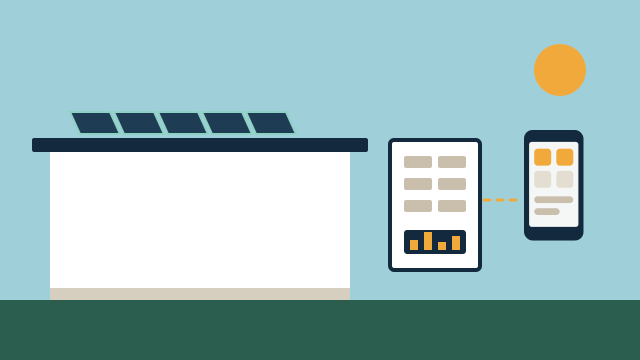
- See whole-property electricity use over time, by the hour, day, or month.
- Spot which large loads, such as air conditioning or a pool pump, use the most.
- View solar production and battery charge next to consumption where the equipment shares that data.
- Get alerts when something runs longer or draws more than expected.
Where it fits
In homes
- Checking how much the air conditioning runs in a second home while nobody is there.
- Seeing whether a pool pump schedule lines up with when you actually need it.
- Following solar production and battery charge in the same dashboard as home use.
In businesses
- Confirming that lights, signage, and equipment actually turn off after closing.
- Comparing energy use across suites or units a property manager oversees.
- Spotting equipment that stays on overnight or on weekends.
What energy monitoring actually shows you
Energy monitoring measures electricity use and presents it as charts and alerts you can read. A monitor at the panel shows how much the whole property uses, and with extra sensors it can show individual circuits such as the air conditioning or the pool pump. Smart plugs and some appliances report their own use. Where supported, solar inverters and home batteries add production and storage data so you can see all of it side by side.
The value comes from patterns. You might notice the AC runs most of the afternoon in an empty unit, or that a water heater draws power at hours you didn’t expect. What you do with that information is your decision; the monitoring makes it visible.
Options for measuring
There are three common approaches, and many projects mix them.
| Approach | What it measures | Typical install |
|---|---|---|
| Panel-level monitor | Whole property, plus selected circuits with added sensors | Inside or beside the electrical panel, by a licensed electrician where required |
| Smart plugs and switches | One device or outlet at a time | Plug-in or replaces a switch; limited to supported loads |
| Solar inverter and battery data | Production, export, and stored energy | Reads data the existing equipment already reports |
Panel monitors give the widest view. Smart plugs are easy to add but only suit plug-in devices within their rated load, and they are not meant for large appliances like an air handler.
How we assess your existing equipment
Many properties already have equipment that reports energy data: a solar system with its own app, a battery, a smart thermostat, or a pool controller. We record exact models and check whether each one offers local access or a supported integration with the platform you use. Platforms such as Home Assistant include an energy dashboard that can combine grid use, solar, batteries, and individual devices, as long as the equipment integrates with it.
If a solar or battery system shares data only through its maker’s cloud, we tell you plainly. That data will pause if the internet or the manufacturer’s service is down.
Connecting energy data to other systems
Energy data becomes more useful when it informs other automation. It can trigger an alert if the AC runs nonstop in a vacant property, or help you plan pool pump schedules and thermostat settings. We set up these connections only where the equipment supports them and you want them.
Illustrative example: A Key Largo second home has solar panels with their own app and a pool pump on an old timer. In this example, a licensed electrician installs a panel monitor, we connect it alongside the inverter data in one dashboard, and the owner gets an alert if consumption stays high for several hours while the house is empty. The owner then decides whether to change the pump schedule.
Florida considerations
Air conditioning is often one of the largest electrical loads in a South Florida property, and a pool pump can be another. After a storm-related outage, a dashboard can show when power returned and whether major equipment restarted, provided the monitor and network come back online.
Getting started
Tell us what you want to understand about your energy use through the free consultation. We’ll contact you as soon as possible and send a proposal that explains which equipment can be read, what needs to be added, and where licensed electrical work is involved.
Scope and planning
What it depends on
- Space in or near the electrical panel for a monitor, where a panel-level monitor is chosen.
- A licensed electrician for any installation inside the panel where required.
- A network connection that reaches the panel or monitor location.
- Exact models of solar inverters, batteries, and smart devices you want included.
Limitations to know
- Monitoring shows how energy is used; it does not lower your bill by itself, and we do not promise savings.
- Solar and battery data is only available where the manufacturer offers a supported integration or local access.
- Some solar and battery systems share data only through the manufacturer's cloud, which needs internet.
- Readings from monitors and smart plugs are estimates and may not match the utility bill exactly.
What affects the cost
- Type of monitoring: whole-panel monitor, circuit-level sensors, or individual smart plugs.
- Number of electrical panels and circuits to measure.
- Licensed electrical work needed for installation inside a panel.
- Integration with solar, batteries, climate, or pool equipment.
- Dashboard and alert setup in the platform you choose.
Every project is quoted individually after the free consultation. There's no minimum project size, and travel is included in the quote.
Questions people ask
Will energy monitoring lower my bill?
Monitoring shows where electricity goes. Any savings depend on the changes you make afterward, such as adjusting schedules or replacing equipment, so we don't promise a number.
Can I see my solar panels and battery in the same place?
Often, if the inverter and battery offer a supported integration. We check the exact models first; some share data locally and others only through the manufacturer's cloud.
Do you work inside the electrical panel?
Panel-level monitors are installed by a licensed electrician where required. We coordinate that work, then set up the monitor, network connection, and dashboards.
Related services
Related reading
- Understanding energy use with monitoring: whole-home, circuit, and plug level
How whole-home, circuit-level, and plug-level energy monitoring differ, what solar and battery visibility requires, and why measuring use is separate from controlling it. -
 Smart thermostats and climate control: comfort, compatibility, and humidity
What smart thermostats do well, how to check compatibility with your HVAC, why humidity matters in Florida, and how remote checks help second homes. -
 Local control vs. cloud automation: what keeps working, and why it matters
How local and cloud-connected automation differ during internet and power outages, vendor changes, and remote access, and which functions should run locally.
Sources
Tell us about your property
Answer a few short questions and the SwayPC team will contact you to arrange your free consultation and proposal. There's no minimum project size, and travel is included in every quote.