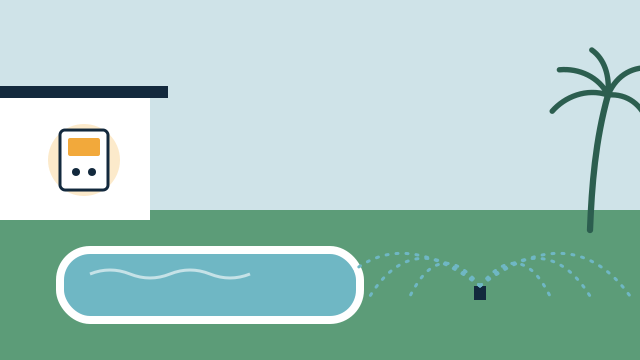
Pool and irrigation automation lets you schedule, adjust, and check outdoor water systems from a phone or a central platform instead of a panel in the side yard. In practice, the pool usually runs on its own manufacturer’s controller, and irrigation runs on a separate controller, ideally one that adjusts to the weather. The planning work is in connecting them sensibly, staying within local watering rules, and making sure the outdoor network and hardware can handle South Florida conditions.
What can pool automation control?
A pool automation system can typically schedule and switch the filter pump, heater or heat pump, pool and landscape lights, a salt chlorine generator, valves that switch between pool and spa, and water features. What your system can do depends on the equipment installed and the controller that ties it together.
Most pool automation is built around a controller at the equipment pad, made by the pool equipment manufacturer, with its own app. That app usually needs an account and a network connection. Hayward’s OmniLogic app listing, for example, says users must create an account and that the controller must be connected to the home router either wirelessly or with an Ethernet cable. Other makers have similar requirements.
Variable-speed pumps add another layer. Many have built-in schedules and speed settings, and some are controlled by the automation system instead. Deciding which device is in charge avoids two schedules fighting each other.
Can pool equipment work with a wider home platform?
Sometimes, and it depends on the exact controller. Some pool systems offer official integrations with other platforms, some have community-built integrations, and some have none. Integrations also differ in whether they work locally on your network or through the manufacturer’s cloud.
When integration works, it opens useful options: pool lights that join an evening outdoor lighting scene, a spa heater started from the same app as the thermostat, or a notification when the pump hasn’t run. When it doesn’t, the pool app remains the main control and the rest of the system works around it. We verify the model and firmware before recommending either path.
Pool electrical work, including bonding, GFCI protection, and new circuits at the equipment pad, is handled by appropriately licensed electricians or pool contractors. Water chemistry stays with your pool service professional. Automation can schedule a salt chlorinator or report a reading the equipment provides, but it doesn’t replace testing and balancing.
How do smart irrigation controllers work?
A smart irrigation controller replaces or adds to a basic timer and adjusts watering based on weather data, soil moisture, or both. The EPA’s WaterSense program describes weather-based controllers as using local weather and landscape conditions to decide when and how much to water, and it labels models that meet its efficiency and performance criteria.
| Controller type | How it decides | Good fit | Watch for |
|---|---|---|---|
| Basic clock timer | Fixed days and run times | Simple yards with consistent needs | Runs regardless of rain unless a sensor interrupts it |
| Weather-based controller | Local weather data and landscape settings | Most residential and commercial landscapes | Needs good zone setup (plant type, sun, soil, sprinkler type) and usually internet for weather data |
| Soil moisture sensor system | Measured moisture in the root zone | Properties where measured conditions matter | Sensor placement and maintenance |
A smart controller is only as good as its zone setup. Each zone should reflect what it waters (turf, shrubs, beds), how much sun it gets, and what kind of heads or drip it uses. Weather adjustments on top of a poor zone setup still produce poor watering.
Most weather-based controllers get forecasts or observations over the internet. If the internet is down, many fall back to their last schedule. Check how your model behaves before relying on it during an extended outage.
What watering rules apply in South Florida?
Landscape irrigation in this region is regulated by the South Florida Water Management District (SFWMD) and by local governments. According to SFWMD, its year-round rule prohibits landscape irrigation between 10:00 a.m. and 4:00 p.m. and limits watering to two or three days per week depending on the area. Specific days depend on your location and address, and local ordinances can differ. SFWMD advises property owners to refer to their local or county ordinance.
Rules can also tighten temporarily during a declared water shortage. Before setting a schedule, check your city or county’s current rules and the SFWMD landscape irrigation page.
Florida law adds one more requirement. Section 373.62 of the Florida Statutes says that anyone who installs an automatic landscape irrigation system must properly install, maintain, and operate technology that inhibits or interrupts the system during periods of sufficient moisture. A rain sensor is the familiar version; some controller features may serve the same purpose. The statute also requires licensed contractors working on these systems to test that device.
Automation helps with compliance by keeping a correct schedule consistently, but it can’t decide the rules for you. Someone has to enter the right days and hours and update them if the rules change.
Illustrative example: A Coral Gables homeowner replaces an old clock timer with a weather-based controller. The irrigation contractor checks the rain sensor and heads, and we set each zone for its plants and sun exposure, enter the watering days and hours from the city’s current rules, and connect the controller to the home platform. A rainy week reduces or skips runs automatically, and the owner gets a notification if the controller goes offline.
Why does outdoor Wi-Fi matter so much?
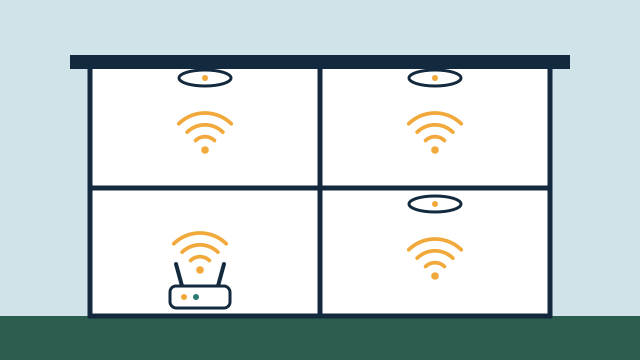
Pool equipment pads and irrigation controllers are often in the side yard, garage, or a utility closet, which are usually the weakest Wi-Fi spots on the property. A controller that drops off the network can’t receive weather updates, report problems, or respond to the app.
Options include a wired Ethernet connection where a cable can be run, an outdoor-rated access point covering the equipment area, or a mesh node placed closer to it. Walls, concrete block, and metal enclosures all reduce signal. We measure coverage at the actual equipment location rather than guessing from the living room. Our article on why networking matters for automation covers this in more depth.
How do salt air and weather affect outdoor equipment?
Salt air near the coast is hard on outdoor electronics, connectors, and enclosures, and South Florida humidity adds to it. Equipment closer to the water or in direct sea breeze tends to need more attention.
Practical steps help. Choose controllers and enclosures rated for outdoor use, mount them out of direct spray and sprinkler overspray, keep cable connections sealed, and include outdoor equipment in periodic inspections. None of this makes equipment immune to corrosion, but it extends the time between problems and makes issues easier to catch early.
Storm season brings its own steps. Before a storm, some owners pause irrigation and adjust pool equipment as their pool professional recommends. After a power outage, controllers should be checked for correct time, schedules, and network connection. Second homes benefit from a status check that confirms equipment came back online. Our guide to second-home automation in the Florida Keys covers remote checks like this.
What are the limits of pool and irrigation automation?
Automation schedules, adjusts, and reports. It doesn’t fix hardware or replace the trades. A broken irrigation head, a cracked lateral line, or a failing pump motor still needs a qualified technician. The EPA notes that even a small leak in an in-ground irrigation system can waste a large amount of water, and a controller won’t necessarily notice one.
Other limits to keep in mind:
- Integrations can change when a manufacturer updates its app, cloud service, or firmware.
- Weather-based adjustments depend on the data source and on correct zone settings.
- Remote control and notifications generally need internet access, both at the property and on your phone.
- Pool and irrigation equipment draws power, so it stops during outages unless it has a backup power source.
If you are curious how much power the pool pump uses, circuit-level energy monitoring can show it. See understanding energy use with monitoring.
How AppxSmart can help
AppxSmart, by SwayPC, starts with the equipment you already have: the pool controller and pump, the irrigation timer and sensors, and the network coverage at each location. We verify which integrations are supported for your exact models, set up schedules that follow your local watering rules, improve outdoor network coverage where needed, and coordinate electrical, plumbing, and irrigation work with appropriately licensed trades. More details are on our pool and irrigation service page.
If you would like a plan for your property, request a free consultation and we’ll contact you as soon as possible.
Questions people ask
Can I control my pool from the same app as my lights and thermostat?
Sometimes. It depends on whether your pool controller offers an integration with the platform you use, and whether that integration is official, community-built, local, or cloud-based. We check the exact controller model and firmware first. When there is no reliable integration, the pool maker's app stays the primary control.
Does a smart irrigation controller know my local watering days?
Not automatically. Some controllers let you enter watering restrictions, and the EPA's WaterSense certification for weather-based controllers considers features like accommodating restrictions. Someone still has to enter the correct days and hours for your address and update them if the rules change.
Do I still need a rain sensor with a smart controller?
Florida law requires automatic landscape irrigation systems to have technology that interrupts watering during periods of sufficient moisture. Depending on the setup, that can be a rain sensor or a controller feature that serves the same purpose. We confirm the approach with the irrigation contractor.