
Motorized shades
Shades that lower for the afternoon sun, open in the morning, and close for privacy without anyone reaching for a cord.
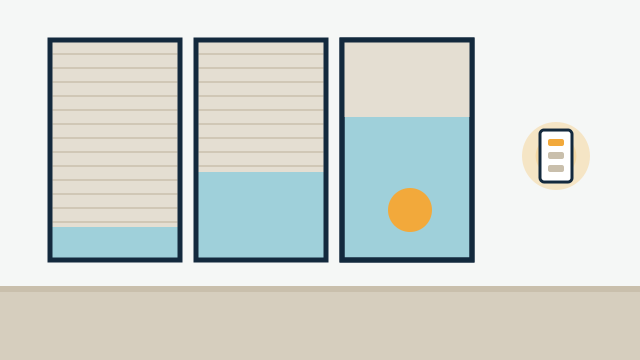
What you can expect
- Shades move by keypad, remote, app, voice, or schedule.
- Groups of windows open or close together as part of a scene.
- Afternoon sun and glare are managed on a schedule tied to the time of day.
- Tall or hard-to-reach windows become easy to operate.
Where it fits
In homes
- Bedroom shades that close at night and open gradually in the morning.
- Living room shades that lower during peak afternoon sun on west-facing glass.
- A second home where shades are set to a closed position while it sits empty.
In businesses
- Conference room shades that lower when a presentation scene starts.
- Lobby or dining room shades that follow a daily schedule.
- Office windows grouped by facade so staff control one side of the building at a time.
Motorized shades solve a few everyday problems at once in South Florida: strong afternoon sun, large glass walls, and privacy at street level. The planning matters more than the motor, because fabric and mounting decisions are hard to change after the shades are made.
How do motorized shades work?
A small motor inside the roller tube raises and lowers the fabric. Each motor responds to a handheld remote or wall keypad, and through the manufacturer’s hub or bridge it can also respond to an app, a voice assistant, or a schedule. Shades can be grouped so one command moves every window in a room or along one side of the building.
Most shade systems communicate over the manufacturer’s own radio and connect to the rest of the property through that hub. That makes the hub location and the network around it part of the design.
How we plan power and mounting
We look at each opening for mounting depth, window size, and what sits around it, such as crown molding or a pocket in the ceiling. Then we pick a power approach. Rechargeable battery motors are the simplest to retrofit. Wired motors, whether low voltage or line voltage depending on the product, avoid recharging but need cable paths, which are easiest to plan during construction or renovation. Wiring is handled by a licensed electrician where required.
In high-rise condos, we also check association rules. Some buildings regulate what is visible from outside, including fabric color on the street-facing side.
How we assess existing shades and controls
If you already have motorized shades, we identify the brand, motor type, and hub. Many systems can be brought into a broader platform through the manufacturer’s bridge. Older or discontinued systems may only work with their original remotes, and we tell you that plainly so you can decide whether to keep them as they are or replace them over time.
For manual shades, we check whether a retrofit motor exists for that system. Often replacement is the cleaner path, and we explain why when it is.
Choosing the fabric
Fabric decides how the room looks and feels during the day. Light-filtering fabric softens light while keeping a view. Blackout fabric suits bedrooms and media rooms. Solar screen fabric is rated by openness, meaning how much of the weave is open, which affects glare, heat, and the view outward. We review fabric options with you, and when an interior designer is involved, we coordinate with their selections.
How shades connect to other systems
Shades are most useful as part of a scene. A “movie” scene can dim the lights through lighting control and lower the shades in the same step. A schedule can close west-facing shades in the afternoon, which helps keep sun off the glass while the climate control system runs. We do not promise specific energy savings, since results depend on the building, the glass, and how the space is used.
Illustrative example: A Brickell office has a conference room with floor-to-ceiling glass facing west. The plan uses battery-powered solar screen shades with a manufacturer bridge, a keypad by the door, and a schedule that lowers them on weekday afternoons. When a meeting starts, one button lowers the shades and sets the lights for presentations.
Next step
Share the rooms and windows you have in mind through the free consultation form, and we’ll contact you as soon as possible to plan measurements and options.
Scope and planning
What it depends on
- Accurate window measurements and mounting depth, which we take or verify onsite.
- A power plan for each shade, either rechargeable battery or wired power.
- Association or landlord approval for any visible changes, where rules apply.
Limitations to know
- Interior motorized shades are not hurricane or impact protection.
- Battery-powered shades need periodic recharging or battery replacement.
- Integration depends on the shade brand's hub or bridge and the exact model.
What affects the cost
- The number and size of openings and how many motors are needed.
- Fabric type, such as light-filtering, blackout, or solar screen.
- Power approach, including whether new wiring is needed.
- Integration with keypads, scenes, and other systems.
Every project is quoted individually after the free consultation. There's no minimum project size, and travel is included in the quote.
Questions people ask
Can you motorize the shades I already have?
Sometimes. Some existing shade systems accept a retrofit motor, while many manual shades are easier to replace. We check the brand, tube size, and mounting before recommending either path.
Do motorized shades need to be hardwired?
No. Many models run on rechargeable batteries, and some offer small solar chargers. Wired power avoids recharging and suits new construction or renovation, with electrical work handled by a licensed electrician where required.
Will the shades work with my smart home platform?
Many shade brands offer a hub or bridge that connects to platforms such as Home Assistant, Apple Home, or Google Home, and some newer models support Matter. We verify the exact model before promising integration.
Related services
Related reading
- How to plan motorized shades for a home, condo, or office
Battery, plug-in, or hardwired power, retrofit or new construction, controls, integration, South Florida sun, and condo rules: what to decide before ordering shades. -
 Lighting scenes for homes and businesses: how to plan them
How to plan lighting scenes for arrival, evening, night paths, and business opening and closing, plus what to check on wiring, dimmers, LEDs, sensors, and controls. -
 Automation planning for builders and interior designers: what to decide and when
When to bring automation into a build or renovation, what to pre-wire, power at shade pockets, keypad placement, the network closet, and a clean handover.
Tell us about your property
Answer a few short questions and the SwayPC team will contact you to arrange your free consultation and proposal. There's no minimum project size, and travel is included in every quote.